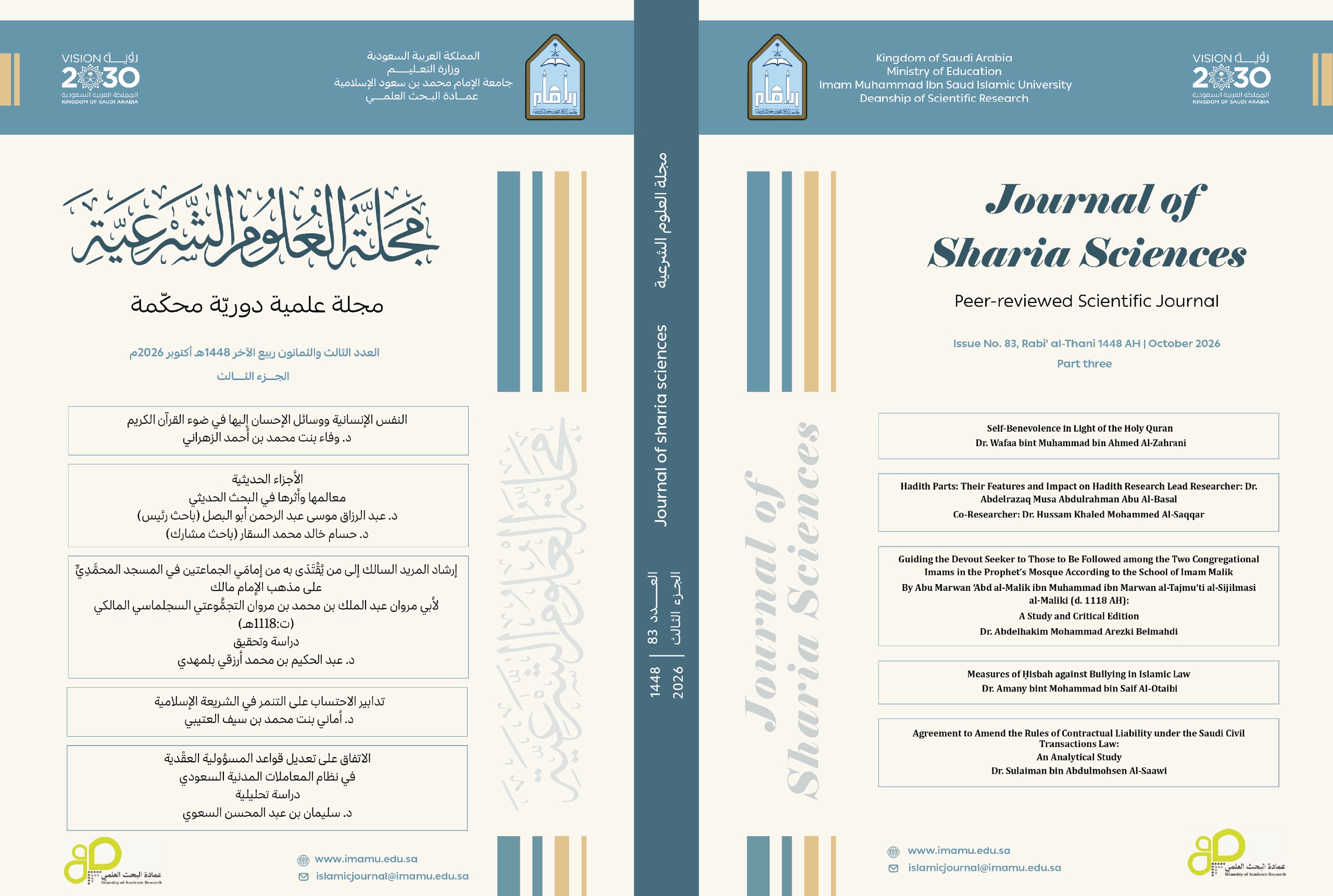

Guiding the Devout Seeker to Those to Be Followed among the Two Congregational Imams in the Prophet’s Mosque According to the School of Imam MalikBy Abu Marwan ‘Abd al-Malik ibn Muhammad ibn Marwan al-Tajmu‘ti al-Sijilmasi al-Maliki (d. 1118 AH):A Study and Critical Edition
Main Article Content
Keywords
Irshād al-Murīd al-Sālik, al-Tajmūʿtī, ʿAbd al-Malik ibn Muḥammad, The multiplicity of mihrabs, The Prophet's Mosque
Abstract
Abstract
This research comprises two principal sections. The first is a biographical-analytical study devoted to examining the life of the treatise's author and establishing his identity. Eastern Islamic sources refer to him solely as ʿAbd al-Malik ibn Moḥammad al-Maghribī, a name that yields no corresponding entry in Maghrebi sources. Through systematic investigation, the author has been identified as ʿAbd al-Malik ibn Muḥammad ibn Marwān al-Tajmūʿtī (d. 1118 AH/1706 CE), a distinguished scholar from Sijilmāsa who undertook a journey to the eastern Islamic lands and resided in the vicinity of the Two Holy Mosques for several years. He served as one of the appointed judges under the Moroccan Sultan Mawlāy Ismāʿīl ibn al-Sharīf al-Ḥasanī al-ʿAlawī.
The second section presents a critical edition of the treatise Irshād al-Murīd al-Sālik, based on two extant manuscripts. The treatise addresses a jurisprudential issue the author witnessed in the Prophet's Mosque: a group of Mālikī worshippers performing congregational prayer either before or after the prayer led by the appointed imam, thereby abandoning prayer behind him. The author grounds his argument on two principles: first, that the appointed imam of the Prophet's Mosque is the sole legitimate leader of prayer in that sacred space; and second, that performing a congregational prayer prior to the appointed imam constitutes an infringement upon his authority, while performing it afterward amounts to repeating congregational prayer within a single mosque — a practice deemed, at minimum, reprehensible (makrūh) in the Mālikī school.
The treatise concludes with commendations, scholarly endorsements (taqrīẓāt), and authorizations (ijāzāt) from leading Mālikī scholars of both the eastern and western Islamic worlds, affirming the author's conclusions.